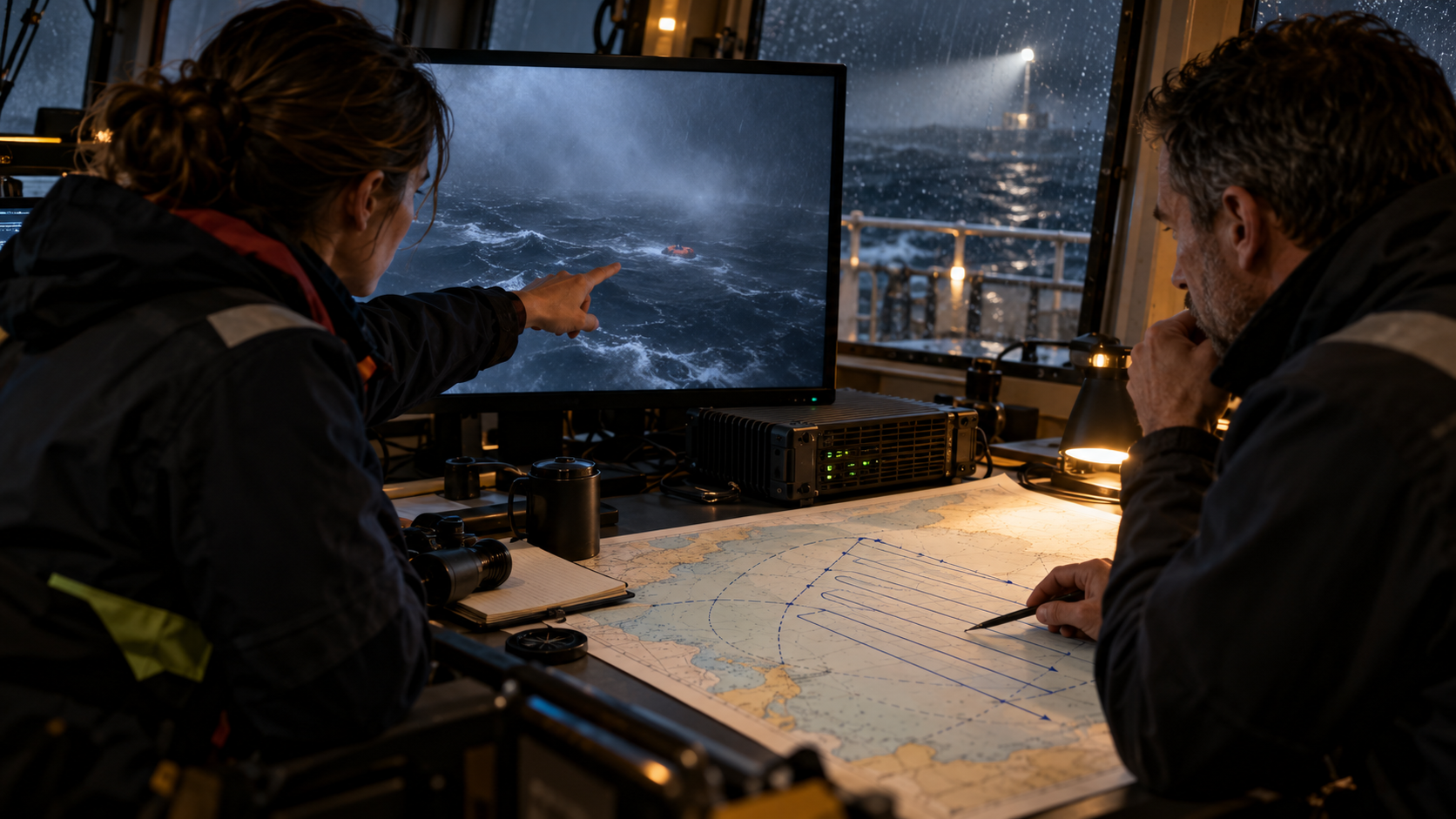
On October 26, the U.S. Coast Guard published a notice of intent to form a Cooperative Research and Development Agreement for testing AI-enabled target detection in search-and-rescue operations. The agency wants to know whether detections from portable edge-computing tools can support a reliable coverage factor, a value used in established search planning. Comments and proposals are due November 25.
The notice calls the proposed technology "Super Intelligence." That is the Coast Guard's term in this document. It does not establish general intelligence, superhuman ability, or proven performance. The proceeding is a technology assessment and participant solicitation. It is not an adoption decision, deployment authorization, procurement award, or safety certification.
What changed
The Coast Guard has opened a public process to test commercially available tools that can detect, classify, and track targets from sensor video while operating at the edge. The systems must be self-contained, portable, and capable of working with different video feeds. The notice identifies low light, fog, precipitation, and rough seas among the conditions the assessment may address.
LOOKOUT is the company currently under consideration. The Coast Guard says the company has demonstrated technical ability and has tools ready for evaluation with agency sensor feeds. Other parties may propose participation, and the agency may select all, some, or none of the proposals it receives.
The planned collaboration has a defined exchange of resources. The Coast Guard would provide staff support and data feeds. A non-federal participant would provide expert staff, equipment and software installation, technical support, and work with the agency on a summary report. The federal party does not fund the participant's contribution under this CRADA, and the Coast Guard will not reimburse proposal-development costs.
The most consequential goal appears near the end of the notice. The Coast Guard wants a framework for determining how effective the tools are at automated target detection and for establishing a reliable coverage-factor value that can support data-driven Lateral Range Curve results.
Why it matters
A lateral range curve describes how the probability of detecting an object changes with the object's perpendicular distance from a searcher's track. The area under that curve is the effective sweep width, a measure tied to the sensor, the search object, and the operating conditions. Coast Guard search theory defines the coverage factor as search effort divided by the area searched. In a parallel-sweep search, it can also be calculated as sweep width divided by track spacing.
That makes the proposed assessment more demanding than a demonstration that finds objects in a sample video. The agency is asking whether performance measurements from an automated detector can contribute to a value used in search planning. A result that changes with the camera, weather, sea state, target type, or computing setup may not transfer cleanly to another mission.
The notice names system confidence and operational performance as evaluation targets, then separately identifies a reliable coverage factor as a research goal. It does not explain how those quantities would be connected. A model's confidence score describes its own assessment of a detection. A coverage factor belongs to the search plan and depends on measured search effort and area. Any attempt to use one system's outputs as evidence for the other would need a test design that preserves that distinction.
If that bridge is weak, a precise-looking number could carry more authority than the underlying evidence deserves. If it is sound, planners would have a measured basis for deciding how an automated detector changes effective sweep width under specified conditions. The notice does not say that this bridge has already been built.
Verification bottleneck
The missing test protocol is the central gap. The notice lists benchmarking, interoperability, data handling, confidence characterization, and operational performance as areas for evaluation, but it does not publish the number or type of targets, sensor configurations, environmental conditions, miss rates, or rules for human review.
False negatives deserve particular attention because a missed target may leave no alert for an operator to inspect. The notice describes tools that would augment existing search-and-rescue workflows, but it does not identify who reviews a detection, how uncertain outputs appear, or how a human override becomes part of the performance record. Those details would affect whether the resulting measurements reflect the tool alone or the combined human-machine workflow.
Sensor compatibility creates another test. "Video-feed-agnostic" is a product requirement in the notice, not a demonstrated result. A benchmark would need to show how performance changes across feeds and whether the same coverage calculation remains valid when the camera, platform, weather, or target changes.
Data handling also matters because the Coast Guard plans to provide test feeds. A credible record would connect each detection and miss to the source feed, conditions, model or software version, confidence output, human action, and final scoring decision. The current notice seeks data-handling best practices but does not specify retention or audit rules.
Watch next
Participant selection will show whether the Coast Guard tests one system or compares several approaches. The eventual statement of work may reveal the benchmark design, including how the assessment counts misses and uncertain detections and how it separates model performance from human review.
The collaborative summary report is the most important later artifact named in the notice. If it becomes public, look for condition-specific results rather than one aggregate score, an explanation of how test results produce a coverage factor, and clear limits on where that value can be reused. A validated result for one sensor, object, and sea state would not automatically establish performance for every search.
Until those details appear, the record supports a bounded conclusion: the Coast Guard is preparing to test whether edge AI can produce evidence useful to established search planning. It has not yet shown that the technology can do so reliably.
Source
- U.S. Coast Guard, Federal Register document 2026-21723, published October 26, 2026.
- U.S. Coast Guard Navigation Center, The Theory of Search, definitions and scientific basis for lateral range curves, sweep width, search effort, and coverage.