Home/Sample analysis
Daily Signal Card · November 8, 2026
The AI Slide Reader Still Ends at the Microscope
On November 5, the FDA added a permanent classification to the Code of Federal Regulations for systems that use machine learning to help review digital cervical cytology slides.
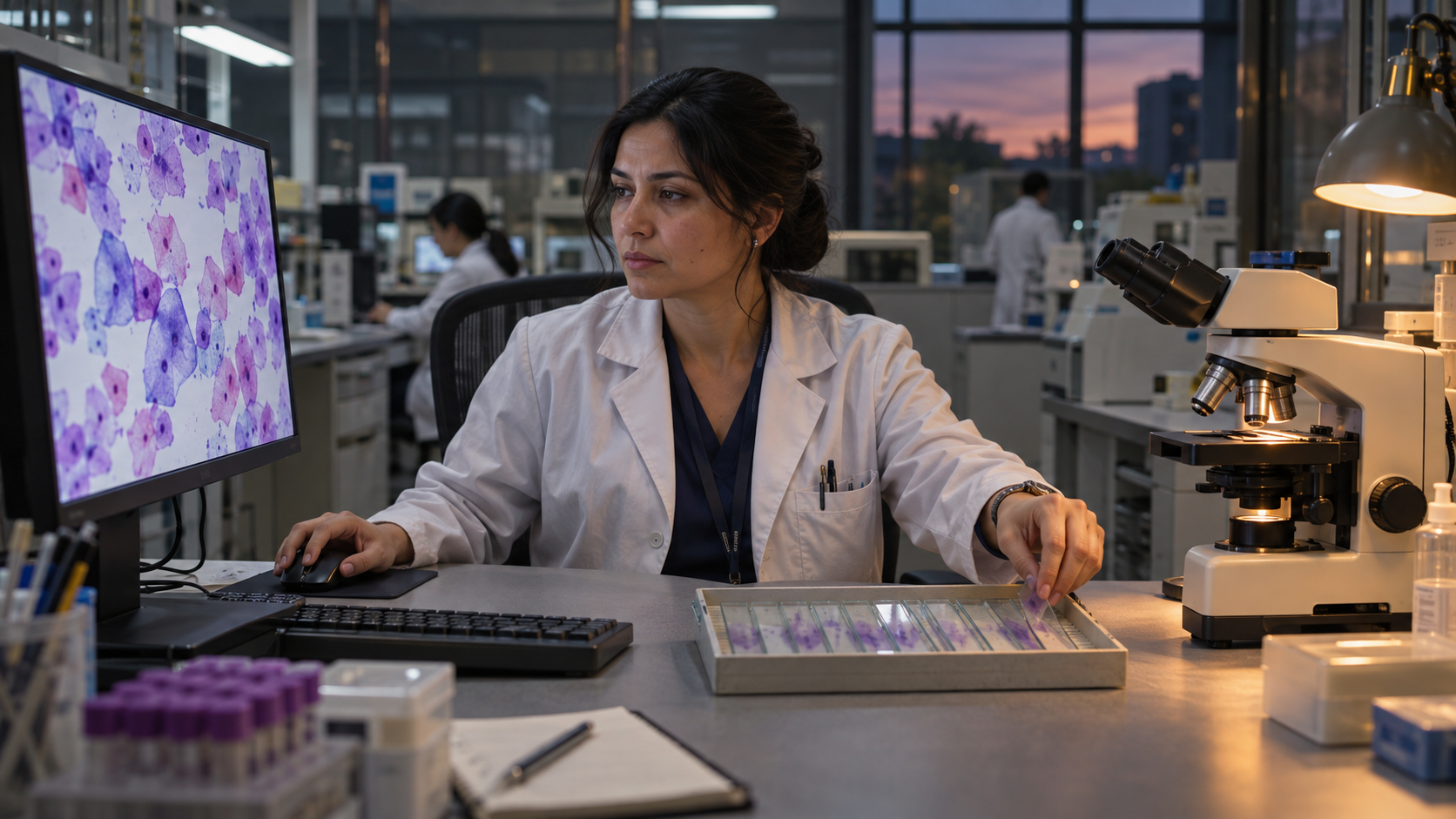
On November 5, the FDA added a permanent classification to the Code of Federal Regulations for systems that use machine learning to help review digital cervical cytology slides. The date can mislead. This was not a new authorization: the agency classified the first device in this category through a De Novo order on January 31, 2024. The newer Federal Register order codifies the evidence and operating requirements that future devices in the category must meet.
What changed
The category covers prescription systems that acquire and manage digital images of cervical cytology slides, then use an algorithm to select and present areas of interest. A qualified cytologist or pathologist still makes the diagnosis. The software points; the human interprets.
FDA identified false negatives and false positives as the central risks. Either can begin with a device that presents the wrong cells or a user who misreads or misuses the system. That makes the review environment part of the regulated system. Scanners, displays, networks, training data, software architecture, cybersecurity, user training and workload limits all matter alongside the model.
The special controls require validation on data kept separate from training and tuning. Studies must include challenging samples, relevant subgroups and potential confounders, with reproducibility testing across operators, scanners and sites. Manufacturers also have to study intended users both with and without AI assistance. That comparison is unusually useful: it asks what the system changes in human performance rather than treating algorithmic accuracy as the whole product.
The fallback remains physical
The controls do not allow reviewers to treat the algorithm's selected regions as the complete case. Users must review the entire gallery and consider patient history, risk factors and applicable clinical guidelines. The original 2024 order adds a plain fallback: when uncertainty remains after digital review, the glass slide should be examined directly by light microscopy.
That requirement captures the operating model better than a claim about “AI in diagnostics” would. The algorithm narrows attention inside a larger chain of evidence. The clinician remains responsible for the call, and the physical specimen remains available when the digital layer does not settle it.
Verification bottleneck
Future submissions will have to document where their validation data came from, which populations and subgroups it represents, what limitations remain, and whether performance holds across the equipment and users named in the submission. Hospitals and laboratories evaluating a cleared system will need to compare those conditions with their own patients, scanners, staffing and workloads.
A clearance can establish that a device met the pathway's requirements under defined conditions. It cannot make local fit automatic. The useful question is whether the evidence matches the place where the system will actually be used.
Watch next
The next signal will come from 510(k) submissions that use this classification. Watch whether decision summaries show independent validation, meaningful assisted-versus-unassisted user studies, subgroup results, and testing across multiple sites and scanner configurations. Those records will show whether the codified framework produces evidence that helps buyers judge local fit, or merely a longer compliance file.
Sources: FDA Federal Register final order 2026-22593, published November 5, 2026; FDA De Novo classification order and decision summary for DEN210035, issued January 31, 2024.