On October 7, 2026, the U.S. Copyright Office opened a public inquiry into music streaming fraud. The notice asks for evidence on bot farms, click farms, playlist manipulation, account hijacking, fraudulent uploads, and the role artificial intelligence may play in scaling those methods. It also asks which countermeasures work and whether Congress should consider new remedies. Written comments are due November 23; reply comments are due December 21.
That inquiry has not produced a rule, an adopted finding, or a measure of how widespread streaming fraud is. It is gathering a record because a single stream count now does several jobs at once. The number can influence royalty payments, playlist placement, recommendation systems, artist discovery, and decisions about where musicians tour.
What changed
This notice puts those connected uses of streaming data into one federal proceeding. Streaming fraud is usually discussed as a royalty problem. The Office is also asking what happens when false listening data spreads into other systems.
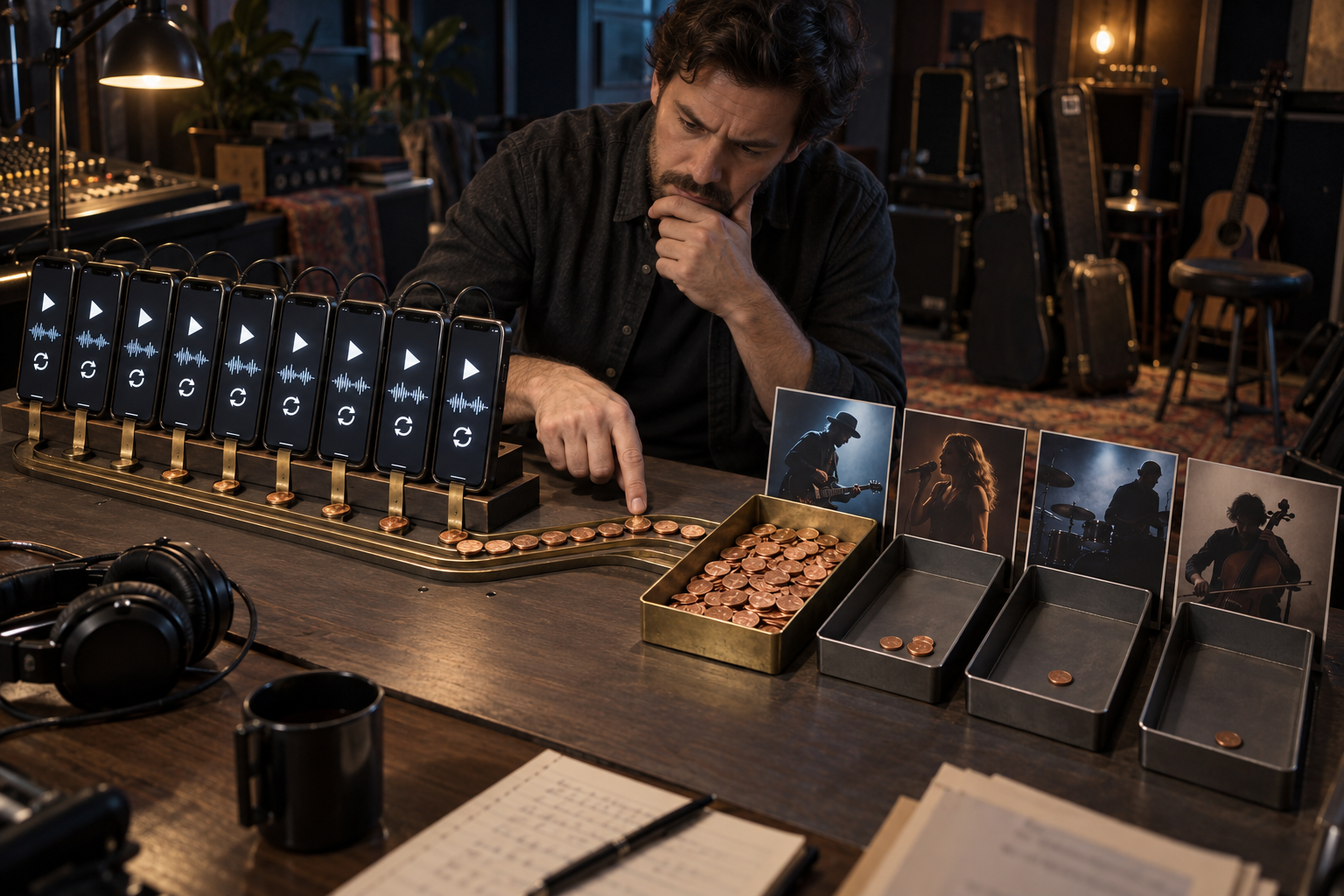
The notice describes how the royalty system works: streaming services generally dedicate a share of revenue to royalty pools and distribute that money in relation to plays. Artificial streams can therefore redirect money away from legitimately played work. The methods listed include automated bot accounts, human click farms, playlists fed by fraudulent traffic, hijacked accounts, and uploads that claim or alter someone else's work.
It also catalogs existing defenses. Platforms may review suspected artificial traffic daily, inspect listening time and geographic patterns, fine uploaders, or accept reports from users and artists. Distributors have added identity checks, know-your-customer controls, trust-and-safety teams, contract penalties, and account closures. Industry groups have pursued data-accuracy work and coordinated responses. The Office is asking whether those measures are effective and what evidence can prove it.
The notice's ten groups of questions cover prevalence and economic impact, the relationship between streaming fraud and AI-generated music, standardized metadata, suspicious-activity reporting, shared databases, voluntary practices, possible legislation, and criminal enforcement.
Why it matters
A fraudulent stream can function as a payment claim even though it looks like audience behavior. Once a platform accepts it, the distortion can move beyond the royalty calculation.
That false audience can affect an algorithmic queue, playlist placement, marketing budgets, and the data artists or venues use to plan tours. Listeners see a popularity signal. Artists see a career signal. Platforms see engagement data. Payment systems use the event to help allocate money. Each may be reading the same corrupted event, which makes repair harder than deleting a suspicious play count.
The AI dimension needs a precise boundary. The notice cites one federal prosecution in which a defendant pleaded guilty in March 2026 after using bot accounts and large volumes of AI-generated songs in a scheme that collected about $10 million in royalties. That is evidence of one scheme. The notice says there is nothing inherently wrong with using AI as a creative tool or with organic demand for AI-generated music. The concern arises when cheap, high-volume content production combines with automated listening and a payment system that accepts each play as evidence of real demand.
But some proposed defenses introduce a separate governance problem. A shared database of suspected abusers could help platforms stop people from moving to a new distributor after detection. It could also spread a mistaken match or disputed accusation across the industry. Any shared system would need defined evidence standards, correction procedures, access controls, and an appeal path. Otherwise, one platform's error could become an industry-wide exclusion that an artist cannot inspect or challenge.
Watch next
Useful comments will supply measured prevalence instead of anecdotes, compare detection methods against false-positive rates, and explain where responsibility sits among platforms, distributors, rights organizations, detection vendors, and law enforcement. Broad claims that the problem is large will not answer the Office's questions about which remedies work.
Watch whether the record separates fake listening, false ownership claims, and large catalogs of low-cost AI-generated music. Fake listening and false ownership involve deception. A large catalog does not become fraudulent simply because AI tools helped produce it.
Information-sharing proposals need the same scrutiny as detection systems. The practical test is whether they can interrupt repeat abuse without converting an opaque internal fraud score into a permanent industry record.