Daily Hypernovelty Lead · Law & evidence · September 30, 2026
Two Million Government Reports Are Still Offline
NTIS says roughly two million government technical reports remain in physical formats. Its digitization request puts fidelity, provenance, and access rules in view.
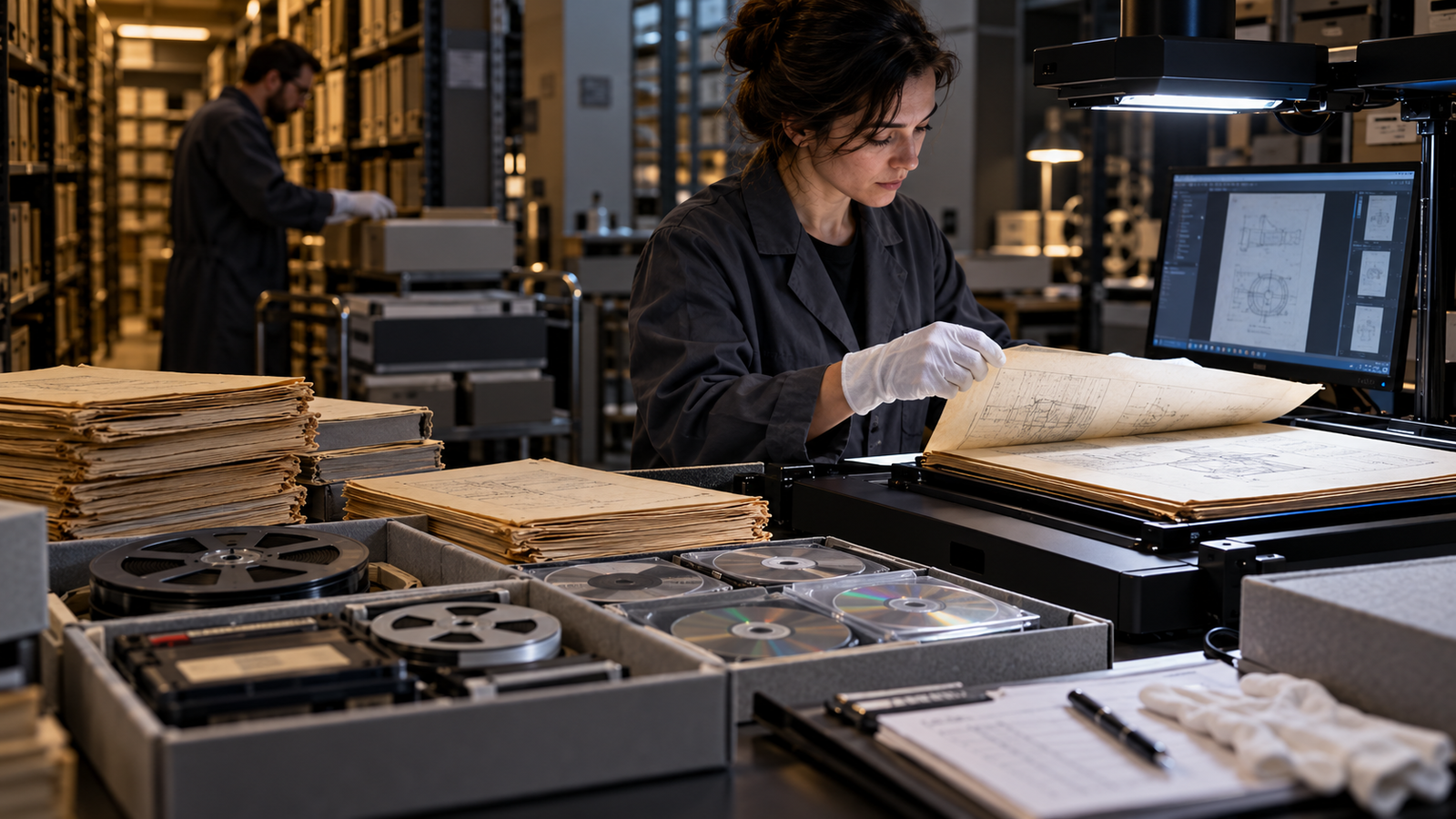
On September 30, the National Technical Information Service asked the public how it should digitize and modernize the National Technical Reports Library, which the agency describes as the largest repository of U.S. government-sponsored technical reports. The request arrives with an unusually concrete inventory: nearly 3 million records dating to the late 1920s, covering more than 350 subjects, with approximately 2 million still held only on paper, microform, tape, CDs, or DVDs. Comments close November 16.
The filing opens a public consultation without funding a modernization program or announcing a procurement. Its questions show why converting an archive of this size involves far more than running pages through scanners.
What is inside the archive
NTIS says the library's reports can contain technical details that journal publications often omit: experimental configurations, failure modes, material properties, measurement results, prototype designs, field tests, engineering tolerances, cost and reliability assessments, negative or inconclusive results, contractor-developed tools, and recommendations for follow-on research.
Because those details are often where the usefulness lives, their loss would change the archive's meaning. A summary may tell a researcher that a design worked, while the underlying report may explain which earlier versions failed, what tolerance made the difference, or where the evidence remained inconclusive. If a digitization system misreads an equation, detaches a caption from a diagram, or drops the qualifiers around a negative result, it creates a searchable record that looks more complete than it is.
That distinction will matter if the collection becomes easier to search with AI. Faster retrieval can widen access to old work, but it can also distribute transcription errors and missing context at machine speed. The archive needs a way to carry its uncertainty forward, rather than polishing every imperfect scan into the same appearance of confidence.
Verification bottleneck
The RFI maps a long chain from physical object to usable digital record, with several points where fidelity can fail quietly.
- Physical custody: NTIS asks how originals should be tracked during pickup, transport, scanning, quality review, and final disposition. A weak custody record could leave an item lost, damaged, or attached to the wrong digital identity.
- Technical OCR: Scientific documents include mathematical notation, chemical formulas, engineering diagrams, tables, headers, footnotes, and multi-column layouts. Software that reads ordinary prose well may still corrupt the part of a report that carries the technical meaning.
- Damaged or incomplete material: The agency asks how to handle low OCR confidence, missing metadata, and illegible pages, including whether a degraded record still has value. A useful system should expose those limits rather than hide them.
- Sensitive content: NTIS asks how automated screening could reduce the risk of exposing restricted, export-controlled, or personally identifiable information. That creates a second verification problem: opening the archive without treating every historical record as automatically safe for unrestricted distribution.
- Version and provenance: The agency asks how digitized records should be versioned and traced for reproducibility and emerging AI-transparency requirements. A corrected scan should not silently replace an earlier version without leaving a record of what changed.
Opportunities
This work could make pre-internet federal research much easier to find and reuse. Search systems could surface engineering context that is currently locked behind catalog entries or physical formats. Researchers could compare old methods, failed approaches, and field results without first locating a reel of microfilm or a disc. Archives and records specialists would have a large, concrete test bed for quality assurance, metadata, sensitive-content screening, and durable provenance.
The RFI also asks what formats would make the collection useful across AI workflows, naming JSONL, Parquet, Markdown, and raw text with metadata sidecars. That opens a practical design question: whether the eventual product will be a pile of extracted text or a research corpus whose tables, diagrams, page relationships, confidence scores, restrictions, corrections, and source identities remain intact.
Meanwhile, access remains unresolved. NTIS asks about bulk distribution, APIs, licensing, public benefit, and cost recovery.
A technically excellent archive can still fall short if access terms keep the most useful forms out of reach, or if commercial reuse strips away the provenance that made the data trustworthy. The delivery rules will therefore determine whether modernization creates a broadly usable public resource, a narrow commercial input, or something in between.
The agency raises one more possibility: whether AI trained on the collection could surface overlooked connections or discoveries buried in decades of hard-to-search research. That is a question in the RFI, not a demonstrated capability. The nearer opportunity is less dramatic and more useful: preserve the government's technical memory well enough that people and machines can inspect what the records actually say, including where they are damaged, uncertain, or incomplete.
As of September 30, no method, vendor, access model, pricing structure, or AI application has been selected. What now exists is an official record of the scale of the problem and a public chance to shape the rules before convenience hardens into infrastructure.