Lead analysis · October 3, 2026
The Tutor Kept Asking After the Student Stayed Stuck
A September 29 preprint built from 1,260 authentic chemistry-tutoring sessions found a problem that is easy to miss when AI is judged one response at a time. As a student remained stuck across several turns, the chance of recovering on the next turn kept falling, even though the tutor could still appear to be doing the approved thing: asking another question instead of giving away the answer.
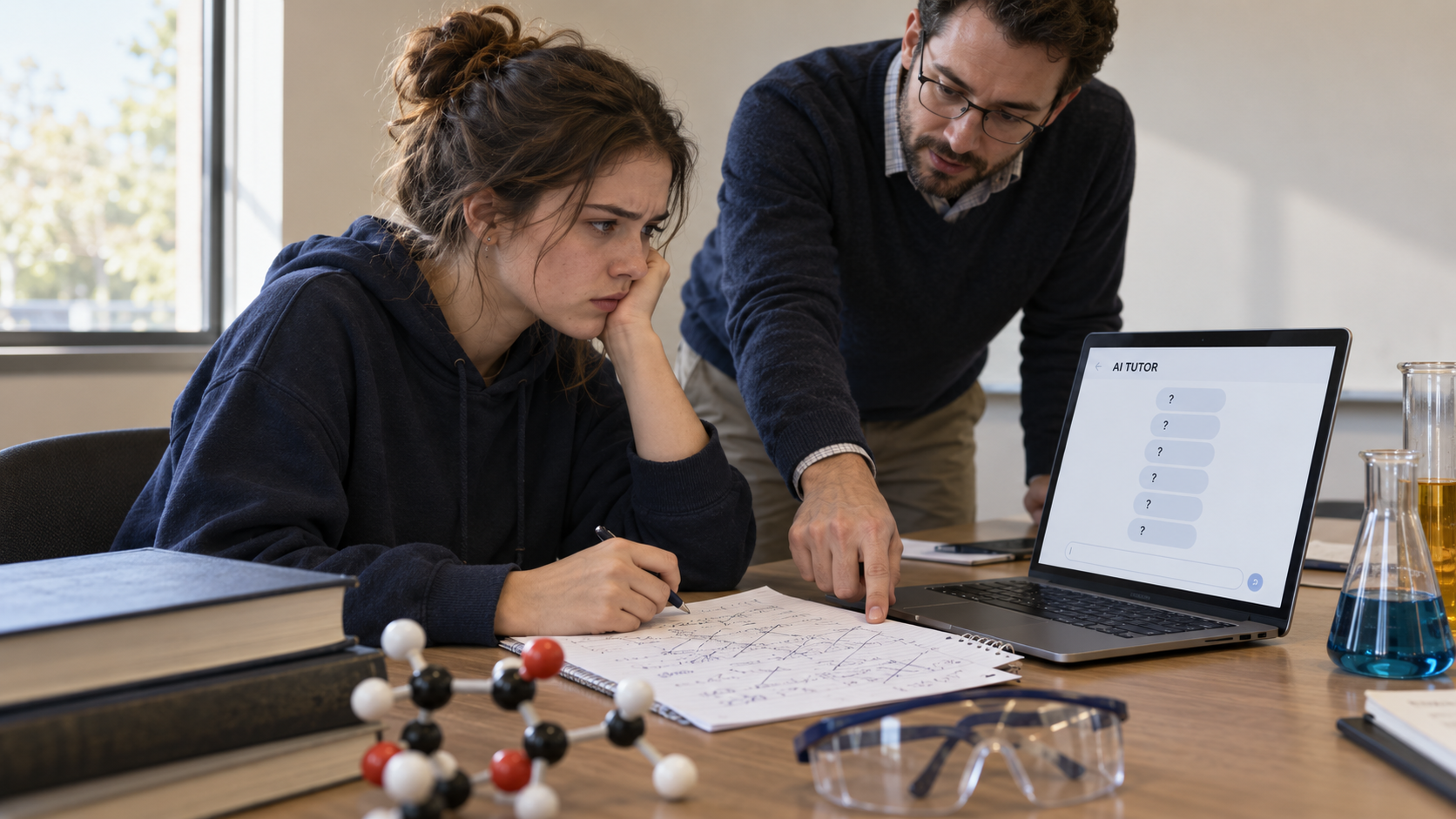
That study examined 20,462 student turns from a standalone GPT-4o tutor used for eight assigned problems in one undergraduate chemistry course at a large U.S. research university. Researchers identified 6,630 impasse turns, grouped into 4,170 episodes across 1,204 sessions. These were moments when a student made a conceptual error, expressed uncertainty, or directly asked for help.
The recovery pattern worsened with each additional stuck turn. Observed next-turn recovery fell from 39.7% at the start of an impasse to 32.6% after a second consecutive stuck turn, 26.2% after a third, and 18.8% at six turns or deeper. In the researchers’ adjusted analysis, every additional impasse turn was associated with about 13% lower odds of recovering on the next turn. The relationship is observational. It does not show that the tutor caused the decline, and the students who reached deeper impasses were already the ones for whom earlier interventions had failed.
When a safeguard becomes a loop
The tutor’s choice of response also tracked with different outcomes. When it followed one scripted question with another, observed next-turn recovery was 28.1%. When it shifted to addressing the student’s specific incorrect answer, recovery was 39.8%. That comparison was adjusted but not randomized, so it should be read as a useful pattern rather than proof that one move caused the improvement.
That policy problem became clearer in a separate controlled replay. The researchers sampled 150 impasses and tested three prompt conditions with GPT-5.6. A baseline prompt produced a direct answer in 50.7% of responses. A strict no-direct-answer prompt asked a follow-up question every time and produced no direct or partial answers. A guided condition used a broader mix of moves.
That replay measured model behavior, not student learning. But it exposed the tradeoff inside a familiar safety rule. A tutor can prevent answer leakage while collapsing into repeated questioning. Each reply satisfies the local instruction. The sequence leaves the learner in place.
The practical unit of supervision is therefore the exchange, not the isolated answer. A useful tutoring policy needs some memory of failed attempts and a planned way to change course. After the first question fails, the system might diagnose the specific error. If that fails, it might offer a targeted hint, then a worked fragment, then a fuller explanation or a route to a human teacher. The right escalation points belong under teacher control.
Verification bottleneck
This is where common AI evaluation methods come up short: they still make it easier to inspect a response than a trajectory. A tutoring system needs evidence that shows how long the student has been stuck, which intervention was attempted at each turn, whether the intervention changed, and whether the student recovered. A loop should become visible before the system quietly repeats the same strategy for a sixth time.
That evidence remains narrow. Next-turn correctness does not show whether learning lasted across days or weeks. The full corpus was coded with an LLM through a human-validated pipeline rather than exhaustive human annotation, and the evidence comes from one tutor in one undergraduate chemistry setting. The result should guide better tests, then be checked in other subjects, age groups, and tutoring designs.
Opportunities
This suggests a sequence-level test: run six- to ten-turn impasse scenarios and score whether the tutor recognizes repeated failure, changes its intervention, and reaches a defensible stopping or escalation point.
The same test can support graduated assistance. Give teachers control over a progression from question to diagnosis, hint, worked fragment, explanation, and human help. Record what happened after each move instead of assuming that continued questioning is productive.
And unresolved exchanges can be flagged for review. A teacher-facing alert can identify a sequence that failed to resolve without turning an automated label into a judgment about the student.
The paper does not settle how every AI tutor should teach. It shows why a system can obey its rule on every turn and still fail the person across the conversation.
Sources