Daily Hypernovelty Lead · Health & evidence · September 25, 2026
The Surgical Robot Is a Chain of Control
The surrounding system has to preserve the practitioner’s authority and make its behavior reviewable across the exact configuration being evaluated.
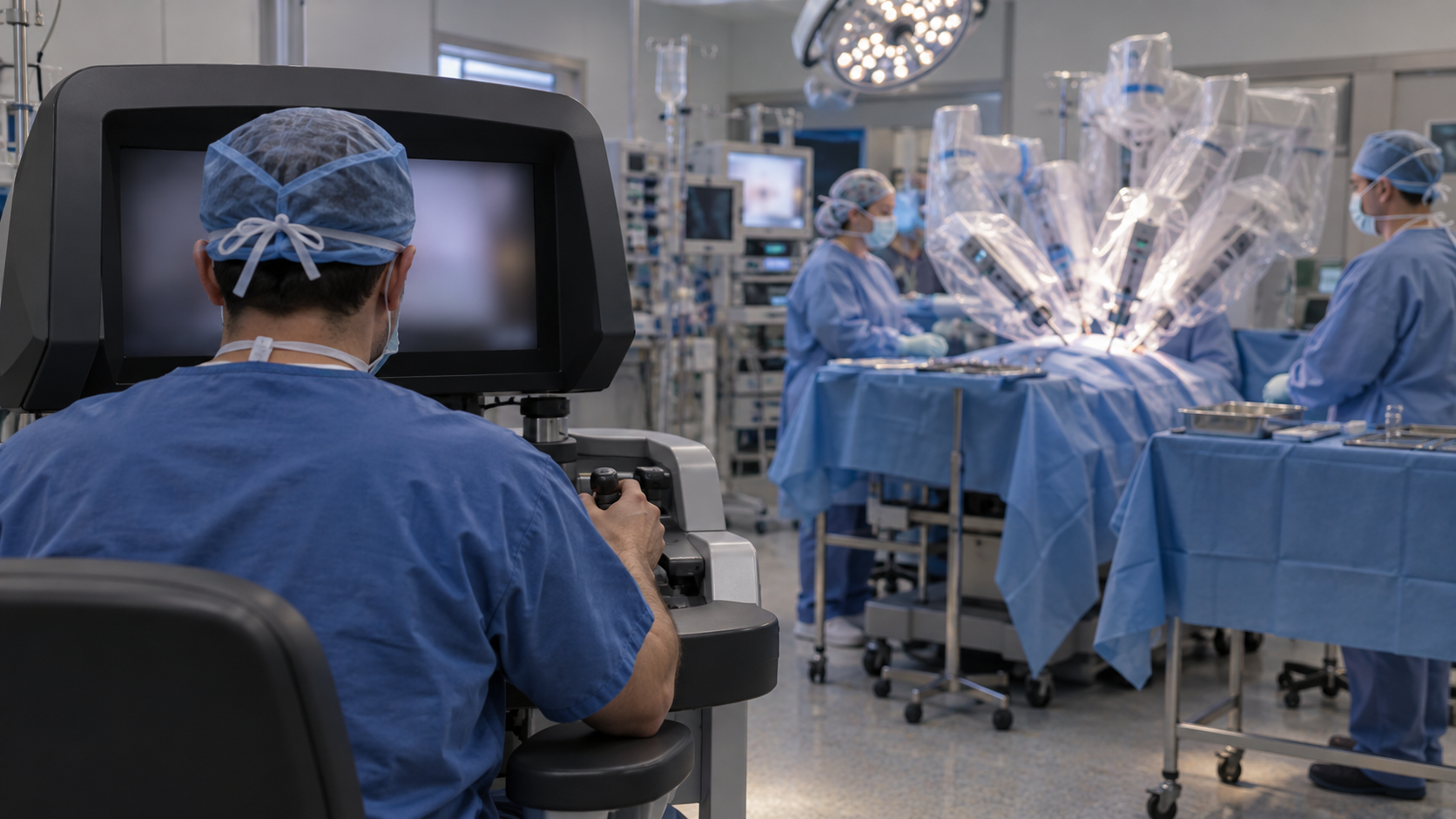
FDA’s September 25 draft guidance for robotically assisted surgical devices maps safety across a complete control loop, from a practitioner’s hand at the console through software and signal transmission to instrument motion, then back through the visual feedback that guides the next movement. The document is marked nonbinding and as a draft that is not for implementation, with comments requested by November 24. It evaluates no named device and makes no finding that a current system is unsafe.
That opening boundary matters because the scope is deliberately bounded. FDA describes the covered devices as teleoperated, software-controlled systems that help qualified practitioners position and control surgical instruments during open, minimally invasive, or endoluminal procedures. They operate under direct control or supervision. Robots that independently perform significant parts of an operation and systems operated from a remote location fall outside this draft, although FDA says some recommendations may still be relevant to devices capable of decision-making or remote teleoperation.
This division of labor turns the device into a connected set of subassemblies. The practitioner uses an operator console. A bedside unit controls instruments and cameras inside the patient, while a third unit supports operating-room hardware and software. Instruments, cameras, accessories, sensors, actuators, displays, and outside services can all affect what the system does. FDA recommends diagrams of those connections and representations of how data moves among them, so a reviewer can see the path from command to physical action rather than inspect each box in isolation.
The result is that a smooth demonstration becomes an incomplete answer. What happens at maximum processing load? What survives an interrupted connection? Does the tested configuration include every intended accessory? Can staff still reach the patient after a fault? FDA recommends testing each subassembly and the whole system, including the instruments, cameras, accessories, and compatible devices intended for use with it.
One of those connections is timing. Total system latency includes the delay from the practitioner’s hand input to instrument motion and from that motion to the corresponding image on the display. FDA recommends measuring it under representative and worst-case conditions, including maximum processing loads and different forms of instrument motion. Motion scaling, tremor reduction, smoothing, and similar input-processing functions are also subject to tests of whether their behavior stays consistent and predictable within predefined tolerances.
Timing is only one part of the failure record. The draft describes how instability across software, hardware, sensors, actuators, and feedback loops could produce unintended motion, delayed response, loss of control, or difficulty reaching the patient during an emergency. Its recommended evidence therefore includes connection integrity, fail-safe behavior, operational limits, fault detection, response, recovery, and emergency access.
Together, those failure records feed a larger evidence file. For non-clinical testing, FDA recommends full reports that state the test objective, method, sample size, results, conclusions, and predefined pass/fail criteria with clinical justification. The reports sit beside recommendations covering software, cybersecurity, wireless technology, human factors, training, reliability, electrical safety, clinical evidence, and labeling. Supervision therefore extends beyond a practitioner remaining in the room. The surrounding system has to preserve the practitioner’s authority and make its behavior reviewable across the exact configuration being evaluated.
The draft may change after comments, and its recommendations do not create binding duties by themselves. For now, it offers a useful map of the evidence needed to evaluate a machine whose movement passes through many technical layers before it reaches a patient.
Verification bottleneck
- Whole-loop timing: The scarce check is whether hand input, instrument response, and visual feedback remain synchronized under representative and worst-case loads.
- Integrated fault behavior: Reviewers need evidence showing what the full system does when a connection, component, accessory, or control layer fails.
- Criteria set in advance: Test reports should identify predefined pass/fail thresholds and the clinical reason for them, rather than fitting a threshold to a completed result.
- Configuration identity: Evidence has to specify which software, hardware, instruments, cameras, accessories, and settings were actually tested together.
Opportunities
A useful review product could be a versioned control-chain evidence packet for complex physical systems. It would connect each tested configuration to its component versions, data paths, latency results, fault scenarios, pass/fail criteria, mitigations, training assumptions, labeling, and unresolved limits. Change one link in the chain, and the packet would show which prior evidence still applies and which tests need another look.
A second service could help research, engineering, and review teams reconstruct the evidence behind a public device summary without making a safety or compliance judgment. The value would come from exposing missing links, conflicting versions, and unsupported carryover between configurations for qualified reviewers to resolve.
This is editorial orientation on a draft agency document, not medical, engineering, regulatory, procurement, or legal advice.