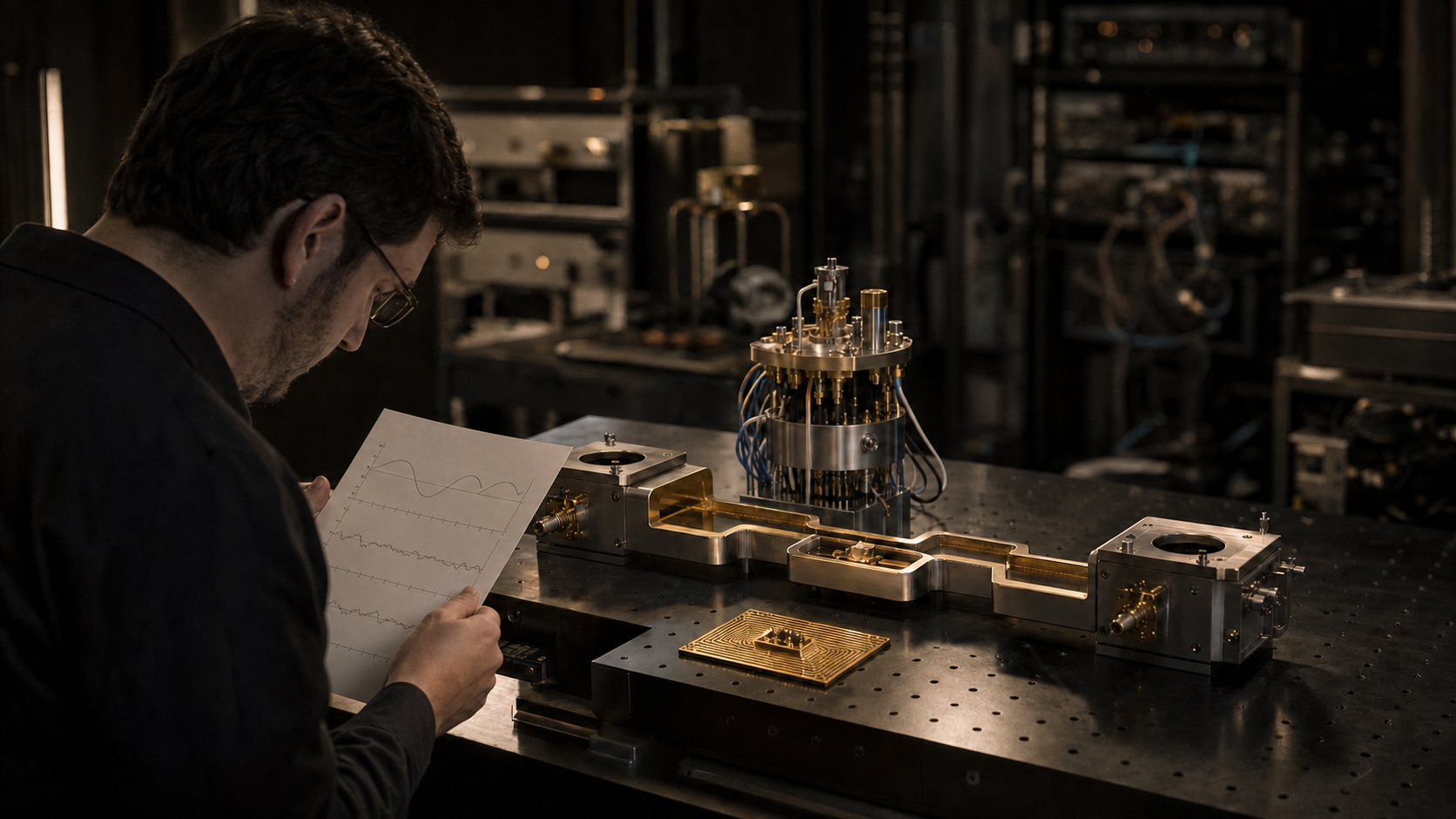
A quantum experiment usually comes with a support system that looks bigger than the thing being studied. Refrigerators hold temperatures near absolute zero. Control lines deliver carefully timed pulses. Detectors collect enough measurements to reconstruct what happened. The tiny quantum device gets the headline while a roomful of equipment keeps it useful.
Three peer-reviewed experiments now point toward a different design direction. Researchers are moving narrow control functions closer to the quantum system itself. One team put a light-sorting function into a fabricated material. Another turned a circuit element into a tunable thermal reservoir. A third used an engineered environment to maintain entanglement between separated qubits.
The experiments use different hardware and solve different problems. Each remains a proof of concept. Their shared pattern matters because the support stack may become the limiting system as quantum hardware grows.
A material that sorts light by its statistics
In a Nature paper published July 15, Chenglong You and colleagues described a quantum statistical plasmonic metacrystal made from 100 gold nanoantennas patterned on a thin gold film over glass.
At room temperature, the structure created allowed and forbidden statistical bands for multiphoton light. Tested fields with statistics inside an allowed band passed through with those statistics preserved. Fields in forbidden bands were suppressed or shifted toward an allowed state.
The careful novelty claim is narrow. The authors describe this as, to their knowledge, the first class of room-temperature materials intrinsically sensitive to the quantum statistical properties and coherence of multiphoton light. The experiment did not produce a room-temperature quantum computer, long-distance quantum transport, a better solar cell, or fault-tolerant processing.
What moved inward was a classification and filtering function. The geometry of the material helped decide which statistical states could travel through it.
A circuit that changes the thermal environment
In Nature Communications, Tuomas Uusnäkki and colleagues reported the first experimental cyclic quantum heat engine built with superconducting circuits. A transmon qubit acted as the working medium. A quantum-circuit refrigerator became one tunable reservoir that sequentially cooled and heated the system.
The researchers ran up to three quantum Otto cycles and measured positive output power and efficiency that agreed with their simulations. This is a microscopic proof of concept rather than a useful power source. It did not show an autonomous engine, quantum advantage, cable removal, or improved logical-qubit performance.
The useful direction sits in the local thermal control. A circuit element can help shape the qubit’s environment instead of leaving every thermal operation to separate external hardware.
An environment that maintains entanglement
A third team, led by A. Andrés-Juanes, used a correlated microwave reservoir to drive two otherwise decoupled superconducting qubits toward a stationary entangled state. Each qubit sat 50 centimeters from the photon source over coaxial cable.
During generation, the system required no measurement, feedback, or time-resolved active control of the qubits. The engineered reservoir continuously pushed them toward the desired state. The measured concurrence was about 0.10, and active methods remain more efficient. Quantum tomography was still required to verify the result.
This was a short laboratory link between two qubits. It was not a practical quantum network. Still, it shows an environment taking on part of the maintenance job instead of acting only as a source of decoherence.
A separate July 15 Nature paper adds context. Researchers used a 54-qubit Quantinuum system to combine the braiding and fusion of simulated non-Abelian anyons into a universal topological gate set and prepared a magic state. They did not perform active error correction. The broader direction is similar: engineered quantum matter is being recruited to carry more of the computational burden.
The knobs are moving inward. The complexity moves with them. Material geometry, reservoir quality, fabrication yield, transmission loss, calibration, and verification become load-bearing.
Verification bottleneck
Verification is becoming the scarce institutional function.
- Quantum design moved faster than repeatable methods for proving that a component preserves its promised behavior after fabrication and integration.
- Researchers, manufacturers, buyers, standards bodies, and future operators now have to verify coherence, loss, fidelity, stability, yield, and the boundary between a controlled demonstration and a system-level gain.
- Watch next: independent replication, larger node counts, longer links, better entanglement, application-level measurements, and evidence that embedded control survives contact with the rest of the machine.
Opportunities
Where value may appear: the measurement and integration layer around embedded quantum control.
A builder could develop component acceptance tests, automated characterization workflows, loss and stability receipts, fabrication-variation benchmarks, or integration records that compare a paper’s controlled result with behavior inside a larger system. NIST’s new Quantum Manufacturing Engineering Center identifies manufacturing of scalable components and enabling equipment such as cryostats and lasers as a national gap. Verification tooling belongs beside that manufacturing push.
This is public-interest orientation and builder idea fodder, not technical, cybersecurity, financial, procurement, or investment advice.
The useful question for operators is simple: did the clever function survive outside the original setup? Track the support stack. That is where a promising experiment starts becoming infrastructure.
Public sources
- You et al., “Quantum statistical plasmonic metacrystals,” Nature, July 15, 2026: https://www.nature.com/articles/s41586-026-10782-3
- LSU, institutional explanation of the metacrystal experiment: https://www.lsu.edu/science/news/2026/07/rt-quantum-material.php
- Uusnäkki et al., “Initial demonstration of a quantum heat engine based on dissipation-engineered superconducting circuits,” Nature Communications: https://www.nature.com/articles/s41467-026-72651-x
- Andrés-Juanes et al., “Distributing stationary qubit entanglement through a non-local squeezed reservoir,” Physical Review X: https://doi.org/10.1103/r4jt-j39w
- Lo et al., “Universal gates from braiding and fusing anyons on quantum hardware,” Nature, July 15, 2026: https://www.nature.com/articles/s41586-026-10709-y
- NIST, Quantum Manufacturing Engineering Center announcement, June 29, 2026: https://www.nist.gov/news-events/news/2026/06/nist-launches-center-drive-manufacture-quantum-technologies