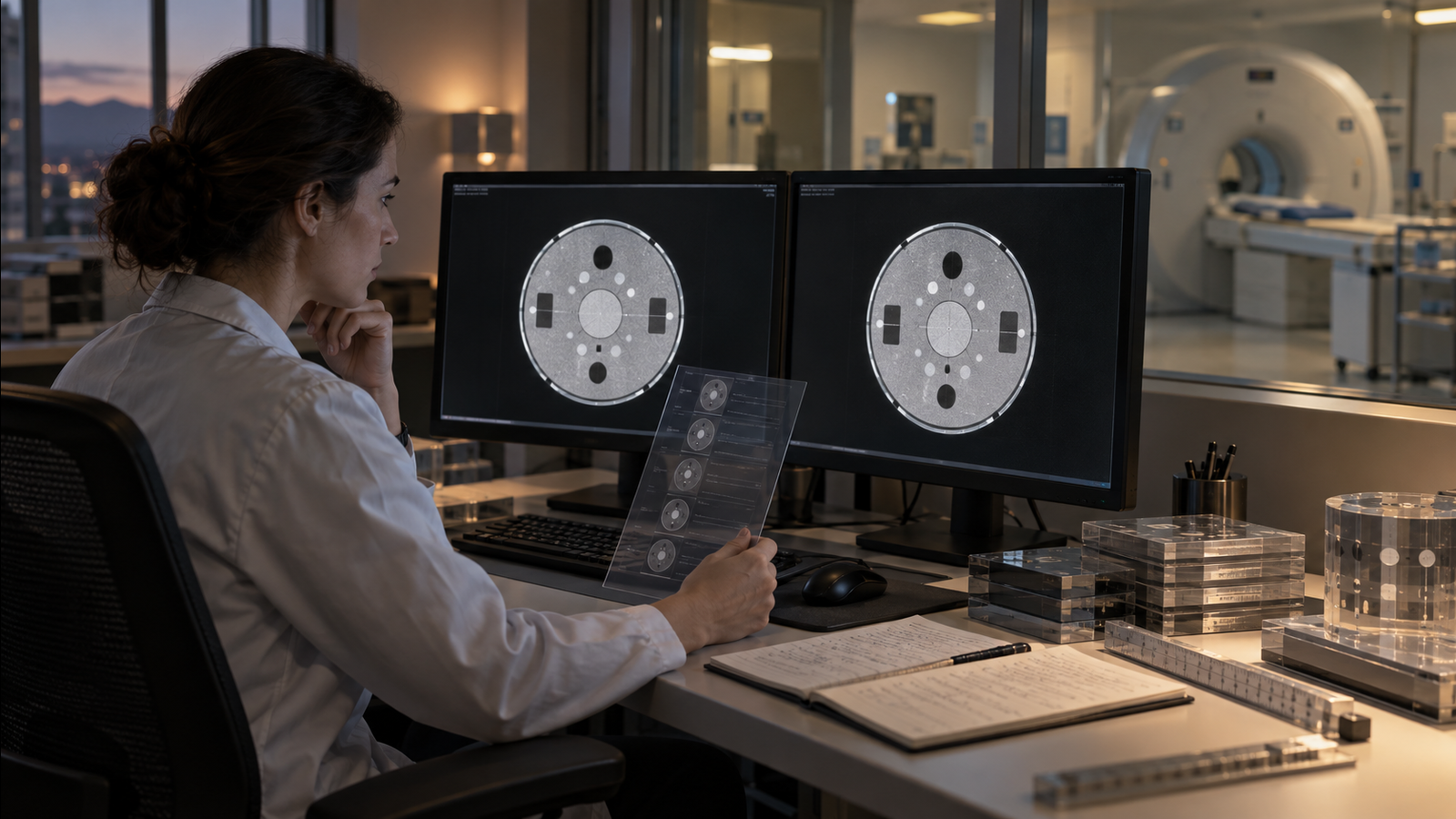
On September 18, the National Institute of Standards and Technology and the National Institute of Biomedical Imaging and Bioengineering opened a public inquiry into the measurements beneath medical imaging, devices, diagnostics, and therapy. Their request asks which areas need better standards or validation, which new measurement categories remain uncovered, and how the standards process should change as medical technology and artificial intelligence evolve.
This inquiry begins with the measurement chain rather than a particular product. NIST defines metrology as the science of establishing precise, reproducible measurements with well-defined uncertainty. In practical terms, a result needs more than a number on a screen. A person reviewing it needs to know what was measured, which reference anchored the measurement, how much uncertainty remains, and whether the result can still be compared across sites and over time.
That definition raises an operational question. As an editorial inference from the measurement problem the agencies describe, comparison may become harder when the instrument stays in place but the system around it changes. Image-processing software may be revised. A device generation may use a different sensor or method. An AI model may add a new analytical step between the original signal and the reported result. The visible number could keep the same label even when part of the path that produced it has changed. The agencies have not reported this as a finding about any named system.
This comparability problem shapes the agencies' questions. The Federal Register notice requests examples of measurements that need improved standards and validation, future measurement areas that current standards do not cover, and changes that could make the standards process more useful amid rapidly changing technology and AI. It also asks for examples of where medical metrology has helped or hindered diagnostics, therapeutic outcomes, and cost efficiency.
Those questions will feed a joint medical-metrology roadmap. According to the notice, the roadmap is intended to identify future needs, major stakeholders, and guidance for future government programs. A September 24 symposium will gather clinical, industry, government, and research perspectives. Its agenda reaches from quantitative imaging and flow cytometry to AI, cloud computing, biophotonic sensing, drug-testing methods, organs-on-a-chip, and proton therapy.
That agenda does not move the process beyond question-setting. The notice is a request for information and a public-meeting announcement. It does not adopt a standard, certify a device, validate a model, establish a clinical result, or show that a named product is safe or unsafe. The roadmap has not been written, and its eventual priorities, funding, adoption, and effects are unknown.
Within that boundary, NIST and NIBIB say better metrology and standards are expected to support improved and more cost-effective healthcare. That is the agencies' rationale for the work. The inquiry itself does not establish those outcomes.
The next evidence will come through the public process. Written comments are due November 30. The symposium is scheduled for September 24, with virtual registration open through September 22. The Federal Register notice says the event will be recorded and transcribed for internal NIST use, so outside review should not assume that a public transcript will follow.
Verification bottleneck
- Change record: A reviewer needs the instrument, software, and model versions that produced a result, including what changed since the previous version.
- Reference path: The record should identify the calibration or reference method and the uncertainty attached to the measurement.
- Comparability: Evidence should show whether results remain comparable across sites, instruments, and updates rather than relying on an unchanged label or display format.
- Process status: A public inquiry, symposium, draft roadmap, consensus standard, and adopted requirement are different stages. Each needs its own status and source trail.
Opportunities
A useful small tool would be a measurement-continuity receipt attached to a result or validation packet. It could record the instrument and site, software or model version, reference or calibration path, stated uncertainty, last material change, and the evidence used to test comparability after that change.
That receipt would not decide whether a system is clinically appropriate or compliant. It could make the measurement history easier for qualified reviewers to inspect and give organizations concrete evidence to contribute to the NIST docket. This is idea fodder, not medical, regulatory, or procurement advice.