Daily Hypernovelty Lead · November 1, 2026
The Machine State Is Moving Outside the Car
On October 26, the National Highway Traffic Safety Administration published a proposal to revise the federal lighting standard for vehicles that may have no steering wheel, brake pedal, or human driver at the controls. Some requirements written around a driver’s hands and feet would apply only to vehicles with manual controls. A second change would let automated-driving vehicles use an optional cyan light to show people outside the vehicle that the automated driving system is in full control and no occupant is expected to monitor the road.
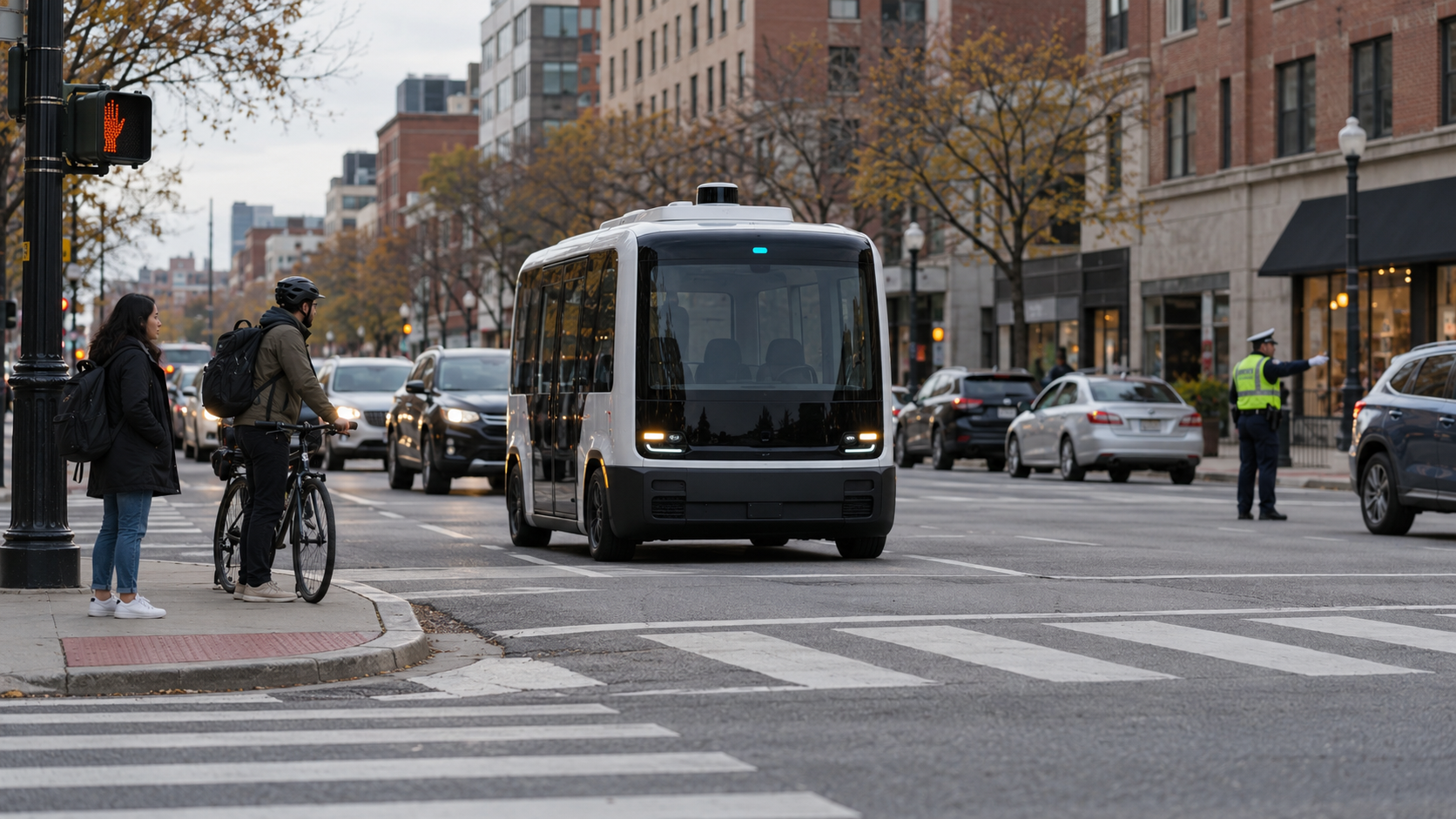
The proposal does not require the marker lamp. NHTSA says it lacks enough evidence to conclude that every vehicle equipped with an automated driving system needs one. Instead, the agency proposes an “if equipped” standard covering the color, placement, activation, visibility, and intensity of front, rear, and side lamps. Comments are due November 25.
That limited scope is important. A cyan lamp would communicate one operating state. It would not certify that the vehicle is safe, empty, error-free, or entitled to special treatment. It would also say nothing about an automated-driving vehicle that does not carry the optional lamp.
The larger change is where the interface sits. Turn signals, hazard lights, and headlamp beams already communicate vehicle action to other road users. The proposed marker would communicate something about who, or what, is controlling the vehicle. A machine state that once lived inside software would become a public signal for pedestrians, cyclists, other drivers, emergency responders, and law enforcement.
NHTSA’s concern is that this signal could become less useful if manufacturers invent incompatible versions. Different colors, placements, intensities, or activation rules could create distraction or confusion and could interfere with required vehicle lighting. The agency’s proposal largely follows the December 2025 version of SAE J3134, although it does not adopt every provision.
Supporting evidence shows interest in a common signal without settling the safety question. An international survey of more than 4,400 drivers found that a majority in each participating country favored marker lamps, including upwards of 80% of respondents in the United States and United Kingdom. That measures preference. It does not show that people can identify a cyan lamp correctly in traffic, distinguish it from other lights, or make a safer decision because they saw it.
The proposal therefore exposes a problem that will recur well beyond vehicles. When software takes over an action that used to have a visible human operator, the system may need to disclose its state to people who never chose the technology and cannot inspect its internal screen. The disclosure has to be understandable at the moment of consequence. A status symbol that requires a manual, changes by vendor, or appears under unclear conditions is weak infrastructure.
Verification bottleneck
- What moved faster: Vehicles without manual driving controls reached public-road testing and limited deployment before the federal lighting standard had a shared external signal for full automated control.
- Who has to verify: NHTSA, manufacturers, human-factors researchers, emergency services, and other road users need evidence that the lamp activates in the intended state and carries a consistent public meaning.
- What the signal must preserve: The light should reveal control state without implying safety, reliability, occupancy, or legal priority.
- What to watch: Public comments, comprehension testing, the treatment of vehicles without a lamp, and any change between the proposal and a final rule.
Opportunities
A useful testing service could measure whether people understand the marker before it becomes familiar street furniture. Trials could compare recognition across daylight, darkness, weather, viewing angles, and mixed traffic, while testing whether the light is confused with emergency or required vehicle signals.
Fleet operators and local agencies may also need a machine-state disclosure map. It would list each external signal, its exact meaning, activation condition, fallback behavior, and the response expected from staff or the public. That is more useful than a generic claim that a vehicle is “autonomous.”
The same pattern can become a design check for other public-facing automated systems: which internal states materially affect nearby people, how those states are disclosed, who verifies the disclosure, and what happens when the signal is absent or wrong. The purpose is not to expose every internal detail. It is to make the consequential state legible where people have to act around it.
Sources
- NHTSA proposed modernization of FMVSS No. 108 for ADS-equipped vehicles, Federal Register, October 26, 2026
- Official Federal Register PDF, GovInfo