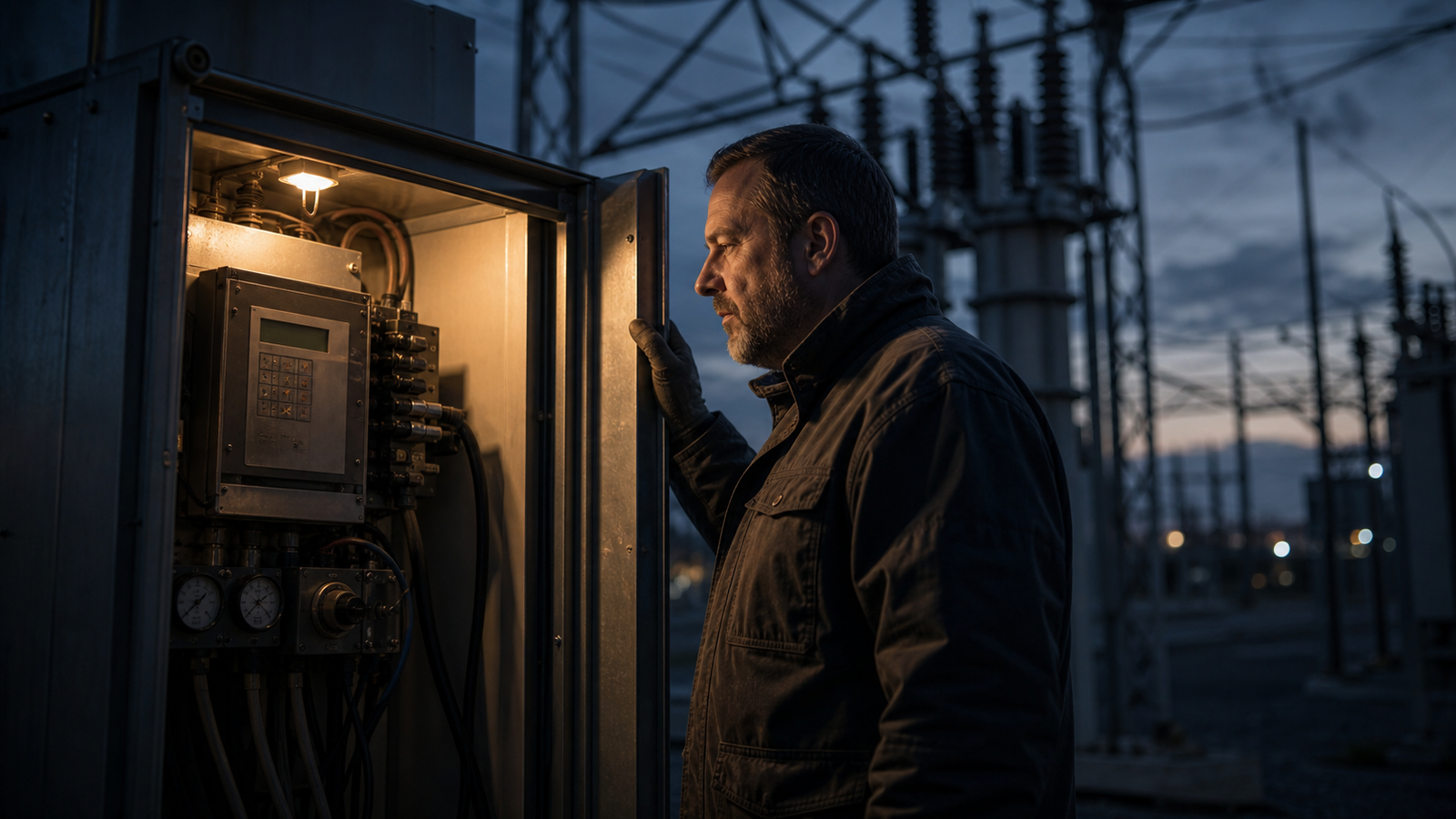
The relay in the substation cabinet is doing its job. It trips faults. It logs. It still accepts firmware over the same remote session it has used for years. The question that just arrived is older than the current outage report: who made this unit, where was it assembled, what software still talks to it, and can it stay.
Executive Order 14421, signed August 26, treats that question as a national-security problem. The order was filed for public inspection on August 28 as Federal Register document 2026-17843, with a publication date of August 31 (91 FR 55995).[1] FederalRegister.gov is the unofficial XML copy. Anyone who needs legal notice should use the official edition on govinfo.
Section 1 then names the pressure in one sentence: "The rapid growth of advanced manufacturing, data centers, artificial intelligence, and defense production has increased the Nation's dependence on abundant, reliable electricity and magnified the consequences of a successful attack or supply disruption on the bulk-power system."[1] The AI buildout is usually argued as a load story. Here it is cited as a reason a disruption would cost more. Extra demand raises the price of a failed transformer or a cut supply of spare parts.
So the emergency object is the equipment that keeps that system running. Section 5 puts substations, control rooms, and generating stations in scope, including transformers, grid-connected inverters, battery energy storage, protective relaying, high-voltage circuit breakers, and industrial control systems such as remote terminal units, programmable logic controllers, and intelligent electronic devices. Agencies may also look at associated software, firmware, remote access, lifecycle maintenance, and other supply-chain dependencies.[1] Models, tokens, and GPUs sit outside that list.
"Foreign-produced," in this order, means an article that is not manufactured, produced, or assembled in the United States.[1] That is a manufacturing test. Later rules still have to decide how firmware, remote-access services, and spare-part chains get treated.
And a new transaction is prohibited only when several conditions stack. The deal has to be initiated after the order date, involve foreign-produced bulk-power equipment in which a foreign country or national has an interest, and receive a Secretary of Energy finding of a Covered Foreign Entity nexus plus an undue or unacceptable risk of sabotage, catastrophic effects, or other national-security harm.[1] Covered Foreign Entity starts with governments and persons tied to a U.S. arms embargo or sanctions regime under ITAR 22 C.F.R. 126.1, and can later include a Secretary determination.[1] The order stops short of proving that any named product currently contains a backdoor. It builds a path for making that call.
Existing cabinets sit in a different clause. After those determinations, the Secretary may put conditions on the continued use of foreign manufactured or operated bulk-power equipment acquired or installed before the order, including requirements to identify, isolate, monitor, secure, disconnect, replace, or remove it. Before isolation, disconnection, replacement, or removal, reliability, safety, replacement availability, and continuity of essential service are supposed to be considered, and compliance may be phased.[1] Separately, as soon as practicable, Energy is to identify Covered-Foreign-Entity equipment that poses those risks and recommend inventory, isolation, monitoring, or replacement.[1]
That is a different cut than The Policy Surface Inside the AI Rack.[2] The August 6 piece followed component provenance inside the data-center enclosure: modules, firmware, and management paths in the rack. This order sits one layer out. It covers the substations, inverters, relays, and control systems that feed the rack. A clean GPU bill of materials still leaves the protective relay unanswered.
Two clocks are now public. Implementing rules are due within 120 days as needed. Federal energy-infrastructure procurement recommendations to the FAR Council are due within 180 days, and the Council then has 90 days to consider proposing amendments.[1] Section 2(e) also lets Energy pre-qualify equipment and vendors.[1] Until those rules and lists exist, the order is a framework with open parameters.
Verification bottleneck
Verification is becoming the scarce institutional function.
- AI and data-center growth can add load faster than utilities, generators, and large customers can produce a current record of who made each in-scope device, where it was assembled, what firmware it runs, and who can reach it remotely.
- Energy, intelligence, and procurement reviewers will have to connect a Covered Foreign Entity finding to actual serial numbers, software, and maintenance contracts.
- Existing units may stay in service while that record is built. Isolation or replacement is supposed to weigh reliability and spare-part availability, which means the inventory has to exist before the hard choice.
- Watch the 120-day rulemaking clock, the 180-day FAR recommendation, any pre-qualified vendor list, and whether agencies publish an evidence standard for origin, firmware, and remote access.
Opportunities
Where value may appear is a bulk-power equipment inventory worksheet for one substation, control room, or generating station. For each in-scope device it would record manufacturer, place of manufacture or assembly, firmware version and update source, remote-access path, who holds credentials, and a replacement lead-time note drawn from the operator's own vendors. That is closer to a hardware bill of materials for the grid cabinet than to a new security product. An HBOM improves visibility. It leaves certification, origin proof, and stay-or-replace decisions to qualified reviewers.
A second opening is a determination-response packet: the same inventory joined to reliability impact, spare-part status, and a named reviewer. Idea fodder only. Not legal, procurement, energy-market, cybersecurity, or investment advice.
The relay can keep working while the record is empty. The expensive part is filling the record before someone else has to guess.
Sources
[2] Hypernovelty Institute, The Policy Surface Inside the AI Rack, August 6, 2026