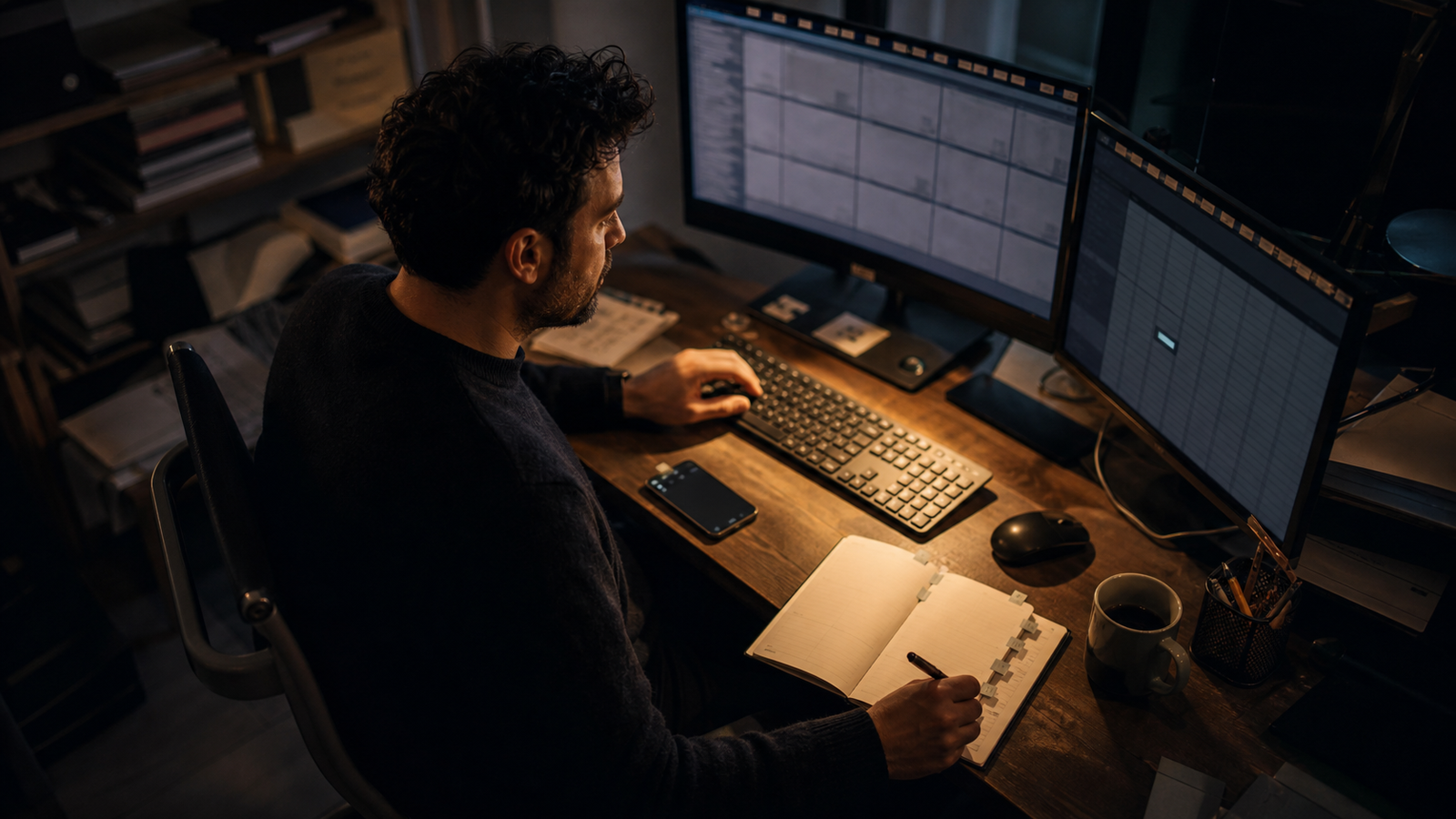
A rough workday can make a capable person look scattered. Thirty browser tabs. Eight chat threads. Several unconfirmed appointments. A spreadsheet waiting for one number from somebody else. Then a meeting cuts across the task that was already cut across by email.
Most workplace measurement smooths that mess into an average. It compares one employee with another, or one company with another, then attaches a story to the difference. A revised research preprint suggests the more useful story may sit inside the same person’s week.
The researchers analyzed about 103 million foreground-application events from 1,017 employees across eight India-based organizations. In their reported variance breakdown, day-to-day differences within the same employee accounted for 44.6 percent of digital fragmentation. Stable differences between employees accounted for 35.8 percent, while differences between organizations accounted for 19.6 percent.
That finding changes the adaptation question. A company looking at a fragmented workflow may be tempted to label the worker, blame the culture, or buy another tool. The study points toward a more immediate question: what happened on this particular day?
Communication-heavy days were more fragmented. Fragmentation rose over the workweek and reset after weekends and holidays. Generative AI use also appeared more often on days when a person’s fragmentation was above their own baseline.
Then the pattern shifted. In the ten application uses immediately after an AI event, workers used fewer unique applications, switched less, stayed longer in applications, and followed a more predictable sequence than they had in the ten uses before it.
That result does not show that AI improved the day. The authors are explicit about the limits. Application traces cannot establish attention, intent, wellbeing, or output quality. The before-and-after pattern is observational. AI use may have arrived when somebody finally reached the part of a messy task where a focused tool was useful. It may have structured the next few steps. It may also have produced polished nonsense in one window. The telemetry cannot tell us.
And that is the part worth holding onto.
Organizations are collecting more traces of work while still struggling to interpret what the traces mean. A lower switching rate can indicate focus, waiting, confusion, or a long video call. A higher switching rate can indicate distraction or competent coordination across several systems. The visible pattern becomes useful only when it is connected to the task, the worker’s experience, and the quality of the result.
The study also creates a privacy problem if used carelessly. Second-by-second application data can become a surveillance system wearing a research badge. A manager does not need a new score for sorting “fragmented” employees. A team needs a bounded way to test whether a workflow reduces avoidable transitions without turning every click into a judgment about the person making it.
That could mean short, voluntary experiments. Pick one recurring task. Compare similar days for the same participant. Record the number of systems involved, the interruptions that arrived, the time required, the worker’s own account of the experience, and a real outcome such as error rate or completion quality. Then remove data that does not help answer the question.
Verification bottleneck
Verification is becoming the scarce institutional function.
- Application telemetry moved faster than the organization’s ability to explain what the pattern means.
- Workers, managers, researchers, and privacy reviewers have to verify whether a changed sequence reflects better work, hidden friction, or a measurement artifact.
- Watch for independent replication, cross-regional studies, task-level outcomes, worker-reported experience, and privacy-preserving measurement designs.
Opportunities
Where value may appear is in workflow measurement that stays small enough to trust. A builder could create a local-first day-comparison tool that keeps raw traces on the worker’s device and exports only agreed summaries. An operations consultant could run voluntary task-transition audits that pair system events with worker notes and actual outcomes. A research team could design deletion rules before collecting a single event.
The useful question is not whether a worker looks busy or whether AI appears in the log. It is whether the shape of the day helped a person do better work without taking away their dignity in the process.
Sources
- Digital Fragmentation and Generative AI Use Across 103 Million Application Events, revised observational preprint, v2.